—Insights—How Bowl Feeders Work in Autoinjector Manufacturing
Scroll
Originally posted on: April 1, 2025
How Bowl Feeders Work in Autoinjector Manufacturing
In the fast-evolving world of medical device production, precision, efficiency, and reliability are non-negotiable.
Autoinjectors are portable medical devices designed to deliver a premeasured dose of medication into the body, typically through subcutaneous (under the skin) or intramuscular (into the muscle) injection, automatically and safely. It enables patients to self-administer medication with minimal training.
The bowl feeder, plays a pivotal role in streamlining the production of autoinjectors, ensuring that core components are handled seamlessly, defects are minimised, and production can scale to meet global demand. Here’s a closer look at how bowl feeders work and why they’re indispensable in autoinjector manufacturing.
Core Components of an Autoinjector
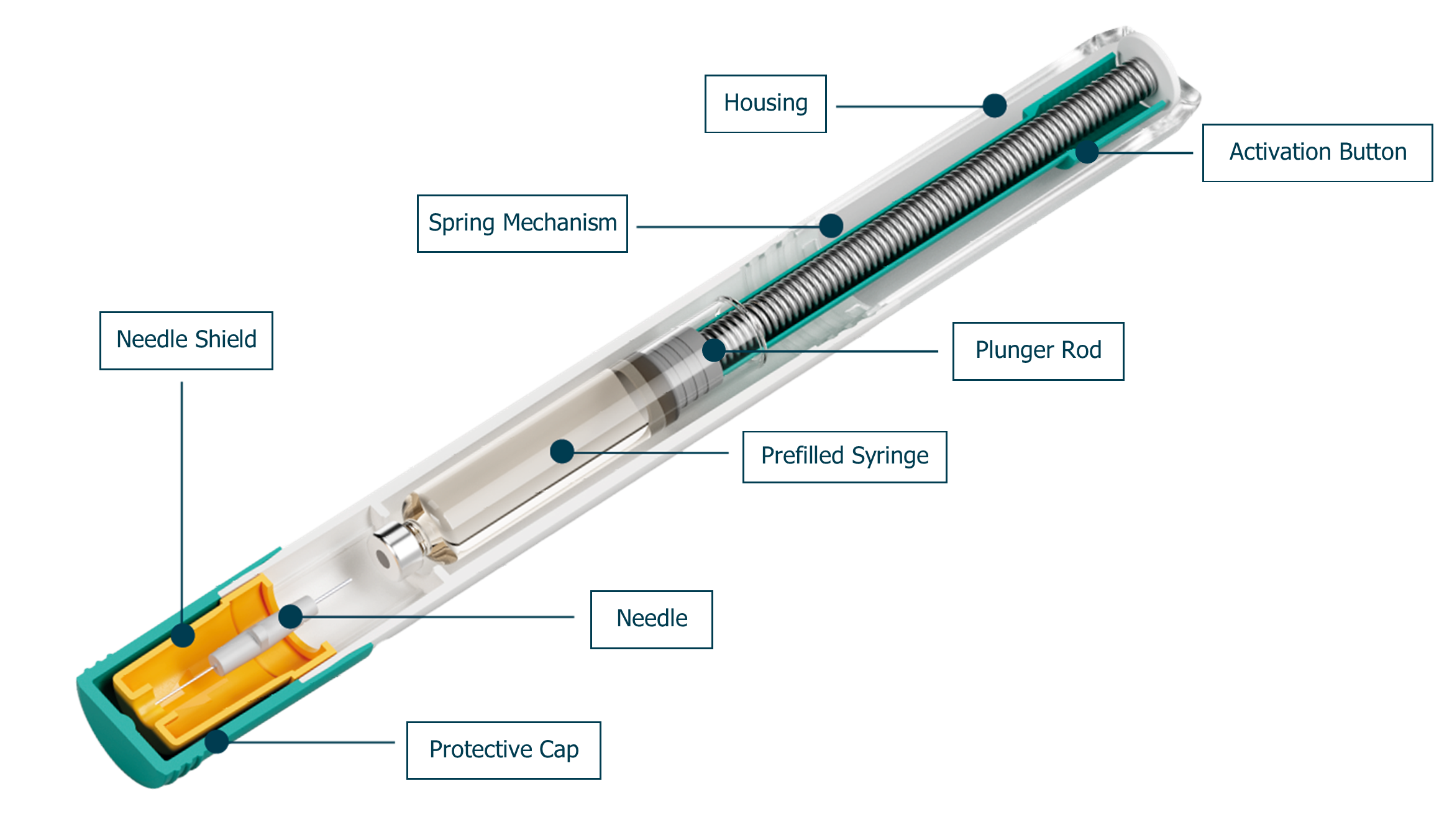
The functionality of an autoinjector relies on several key components working together. These core elements are:
Housing (Outer Shell): Provides ergonomic grip and structural support.
Needle: Includes the needle and mechanism to extend/retract it safely.
Needle Shield or Cover (Post-Injection): Prevents accidental needle sticks before and after use.
Prefilled Syringe (Cartridge): Contains the medication to be injected.
Plunger Rod: Pushes the medication out of the syringe or cartridge through the needle.
Spring Mechanism: Generates the force required to push the plunger and deliver the dose.
Activation Button: Starts the injection process.
Inspection Window: A visual cue, like a window or marker to provide confirmation of successful injection.
How Bowl Feeders work in autoinjector manufacturing?
1. Vibration Motion
The bowl feeder vibrates at a tuned frequency, causing parts to move along a spiral track around the edge of the bowl.
2. Component Handling
Small parts like syringe barrels, plungers, springs, needle assemblies, or safety caps are loaded into the bowl, often from a hopper for continuous supply. The vibration propels these components upward along the track.
3. Orientation Mechanisms
The bowl’s interior is customised with ramps, slots, or guides specific to each component. For example:
Syringe Barrels: Tooling ensures they exit flange-up for plunger insertion.
Springs: Guides align them vertically or horizontally, depending on assembly needs.
Safety Caps: Cutouts orient them to fit over the needle end. Misaligned parts fall back into the bowl or are diverted, ensuring only correctly positioned items proceed.
4. Integration with Assembly
At the track’s exit, components are fed directly to robotic arms, conveyors, or workstations. For instance, a bowl feeder might deliver plungers to be pressed into syringe barrels or springs to be loaded into the housing, aligning with the high-speed, precision demands of autoinjector production.
5. Efficiency and Precision
The vibration rate and tooling are fine-tuned to match the component’s size, shape, and weight, as well as the production pace. This ensures a steady, error-free supply, critical for assembling complex devices like autoinjectors where tolerances are tight and quality is non-negotiable.
In autoinjector manufacturing, RNA bowl feeders streamline the handling of core components, which are then fed to automated assembly stations where they’re integrated step-by-step. This process reduces manual labour, minimises defects, and enables scalable, high-volume production while meeting the medical industry’s rigorous standards.
Get exciting news and updates in the future. See our Privacy Policy to learn how we protect your information.
We use cookies to give you the best experience on our site. By using our site you accept our Privacy policy. Accept
Manage consent
Privacy Overview
This website uses cookies to improve your experience while you navigate through the website. Out of these, the cookies that are categorized as necessary are stored on your browser as they are essential for the working of basic functionalities of the website. We also use third-party cookies that help us analyze and understand how you use this website. These cookies will be stored in your browser only with your consent. You also have the option to opt-out of these cookies. But opting out of some of these cookies may affect your browsing experience.
Necessary cookies are absolutely essential for the website to function properly. These cookies ensure basic functionalities and security features of the website, anonymously.
Cookie
Duration
Description
cookielawinfo-checkbox-analytics
11 months
This cookie is set by GDPR Cookie Consent plugin. The cookie is used to store the user consent for the cookies in the category "Analytics".
cookielawinfo-checkbox-functional
11 months
The cookie is set by GDPR cookie consent to record the user consent for the cookies in the category "Functional".
cookielawinfo-checkbox-necessary
11 months
This cookie is set by GDPR Cookie Consent plugin. The cookies is used to store the user consent for the cookies in the category "Necessary".
cookielawinfo-checkbox-others
11 months
This cookie is set by GDPR Cookie Consent plugin. The cookie is used to store the user consent for the cookies in the category "Other.
cookielawinfo-checkbox-performance
11 months
This cookie is set by GDPR Cookie Consent plugin. The cookie is used to store the user consent for the cookies in the category "Performance".
viewed_cookie_policy
11 months
The cookie is set by the GDPR Cookie Consent plugin and is used to store whether or not user has consented to the use of cookies. It does not store any personal data.
Functional cookies help to perform certain functionalities like sharing the content of the website on social media platforms, collect feedbacks, and other third-party features.
Performance cookies are used to understand and analyze the key performance indexes of the website which helps in delivering a better user experience for the visitors.
Analytical cookies are used to understand how visitors interact with the website. These cookies help provide information on metrics the number of visitors, bounce rate, traffic source, etc.
Advertisement cookies are used to provide visitors with relevant ads and marketing campaigns. These cookies track visitors across websites and collect information to provide customized ads.