Originally posted on: April 1, 2025
Optimizing Autoinjector Assembly with Precision Bowl Feeding Systems
Author: Chris Mills

In the fast-evolving world of medical device production, precision, efficiency, and reliability are non-negotiable.
Autoinjectors are portable medical devices designed to deliver a premeasured dose of medication into the body, typically through subcutaneous (under the skin) or intramuscular (into the muscle) injection, automatically and safely. It enables patients to self-administer medication with minimal training.
The bowl feeder, plays a pivotal role in streamlining the production of autoinjectors, ensuring that core components are handled seamlessly, defects are minimized, and production can scale to meet global demand. Here’s a closer look at how bowl feeders work and why they’re indispensable in autoinjector manufacturing.
Core Components of an Autoinjector
- Housing (Outer Shell): Provides ergonomic grip and structural support.
- Needle: Includes the needle and mechanism to extend/retract it safely.
- Needle Shield or Cover (Post-Injection): Prevents accidental needle sticks before and after use.
- Prefilled Syringe (Cartridge): Contains the medication to be injected.
- Plunger Rod: Pushes the medication out of the syringe or cartridge through the needle.
- Spring Mechanism: Generates the force required to push the plunger and deliver the dose.
- Activation Button: Starts the injection process.
- Inspection Window: A visual cue, like a window or marker to provide confirmation of successful injection.
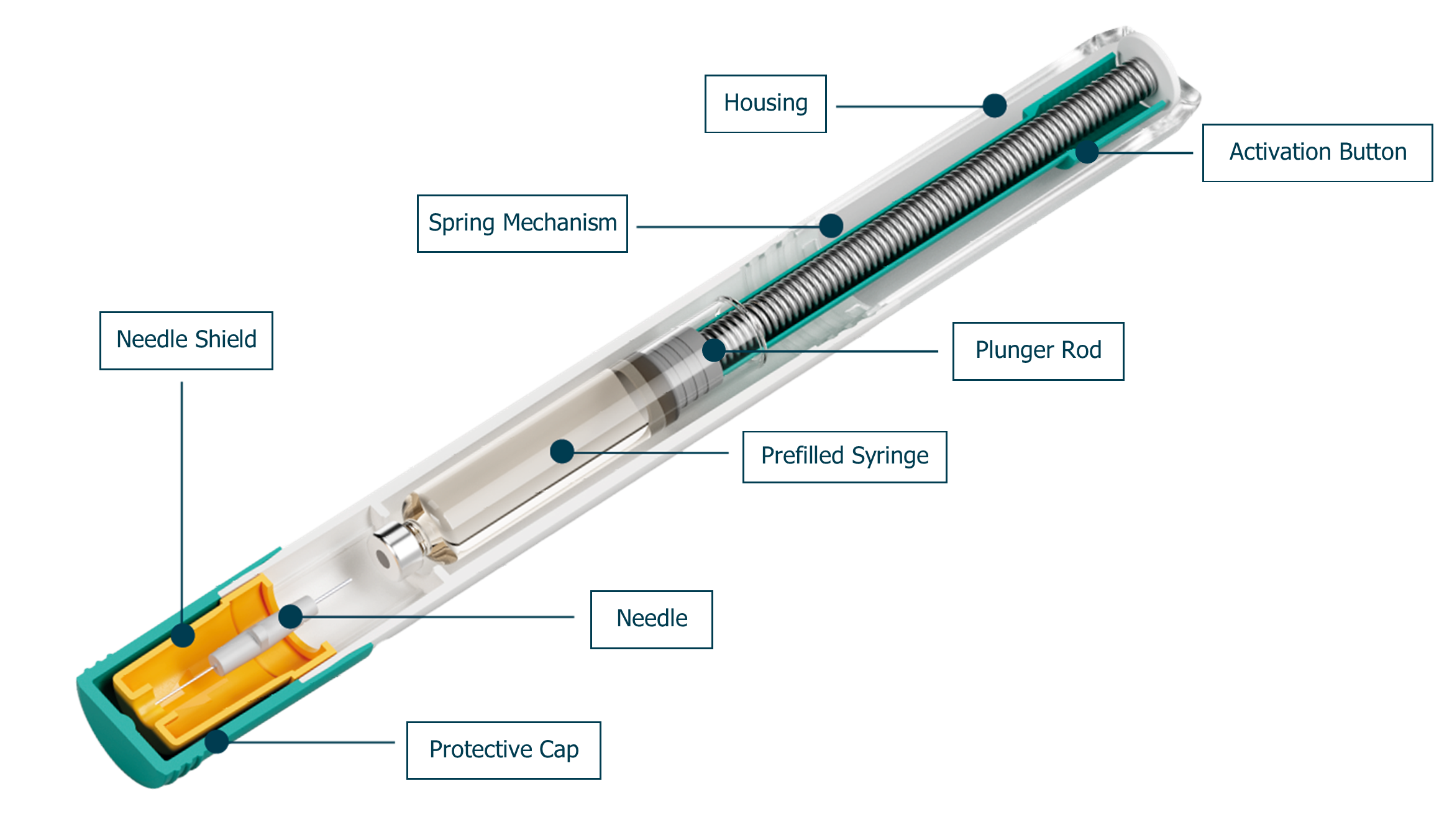
How Bowl Feeders work in autoinjector manufacturing?
1. Vibration Motion
2. Component Handling
3. Orientation Mechanisms
- Syringe Barrels: Tooling ensures they exit flange-up for plunger insertion.
- Springs: Guides align them vertically or horizontally, depending on assembly needs.
- Safety Caps: Cutouts orient them to fit over the needle end. Misaligned parts fall back into the bowl or are diverted, ensuring only correctly positioned items proceed.
4. Integration with Assembly
5. Efficiency and Precision
In autoinjector manufacturing, RNA bowl feeders streamline the handling of core components, which are then fed to automated assembly stations where they’re integrated step-by-step. This process reduces manual labour, minimises defects, and enables scalable, high-volume production while meeting the medical industry’s rigorous standards.
Talk to an RNA engineer about your application.
High-Performance Standards for Medical Autoinjector Assembly
Deploying bowl feeders in autoinjector manufacturing demands far more than mechanical reliability. RNA’s automated feeding systems for medical devices are purpose-built to meet the rigorous compliance, speed, and handling requirements of pharmaceutical and medical OEM production lines.
Cleanroom Compatibility
Cleanroom compliance is a defining requirement in autoinjector assembly automation. RNA feed systems are engineered with materials and finishes that minimise particle generation — including 304/316L stainless steel surfaces with fine polishing to prevent abrasion and dust. Enclosures are designed to reduce airflow turbulence and contain potential contaminants.
Every system is accompanied by detailed documentation covering material traceability, assembly processes, and cleanroom qualification — ensuring regulatory alignment with ISO Class 7 cleanroom environments or better. This makes RNA’s pharmaceutical bowl feeders a trusted choice for manufacturers operating under FDA, EU MDR, and cGMP frameworks.
High-Speed Feeding for Demanding Production Schedules
RNA excels in high-speed feeding solutions, delivering up to 1200 parts per minute for demanding medical applications. Vibratory bowl feeders and linear systems, optimised with multi-lane tracks and precision-tuned vibrations, ensure rapid and consistent autoinjector component delivery without compromizing accuracy.
Custom-engineered tooling minimises downtime, maintaining ISO 7/8 standards even at maximum production speeds to enhance overall equipment efficiency (OEE).
Gentle Handling of Fragile Medical Components
Many autoinjector components — syringe caps, autoinjector housings, needle shields, and inhaler parts — are small, lightweight, and highly sensitive to mechanical stress. RNA feed systems are designed with geometry-specific tooling, smooth surfaces, and controlled feed motion to eliminate damage or stress during handling.
Custom tooling and soft-touch coatings, including FDA-approved polyurethane, prevent scratches and deformation. Step feeders employ elevator-based systems for smooth, low-impact delivery — ideal for fragile parts. Flexible feeding solutions ensure accurate robotic picking, reducing mechanical wear.
By prioritizing gentle handling, RNA ensures high yields, preserves component integrity, and supports manufacturers in maintaining strict quality standards and validation protocols across sensitive medical device automation applications.
Advancing Precision: A Technical Guide to RNA Feed System Innovations
As autoinjector designs become more compact and assembly speeds increase, the feeding system must evolve from a simple vibratory tool into a precision-engineered, data-driven asset. For a comprehensive look at how RNA is redefining these standards for the medical sector, explore our full white paper: [Precision Feeding for Medical Manufacturing: RNA Innovations in Feed System Design]

Also available in:
 English
Last edited on: March 30, 2026
