Originally posted on: September 18, 2026
How Gradual Tooling & Coating Wear Silently Reduces Feeding Performance
Feeding systems rarely lose performance overnight. More often, performance declines gradually as tooling and coatings wear through repeated contact with components.
A coating becomes smoother. A tooling edge begins to round. Parts take slightly longer to orient. The feeder still runs, so these changes are easily mistaken for normal process variation.
Over time, however, small changes can lead to lower feed rates, unstable orientation, increased recirculation and more frequent stoppages.
Why Feeder Wear Is Easy to Miss
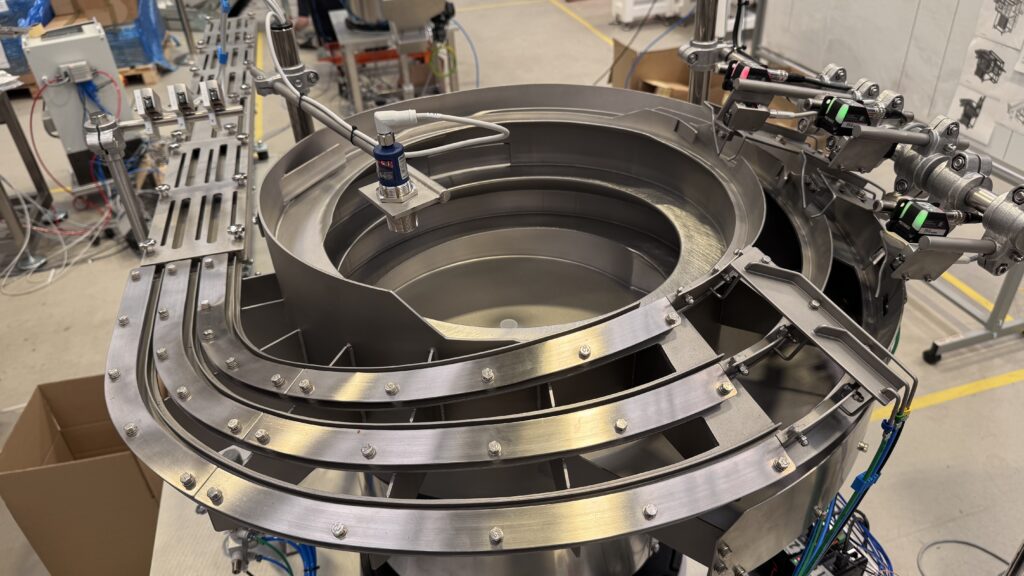
Feeding systems rely on precise geometry, surface friction, and tuned dynamics to move and orient parts. When a feeder is new, the track interface is optimal. Over millions of cycles, that interface degrades:
- Friction Drift: Coatings like polyurethane, PTFE, or custom sprays provide the friction needed to drive parts forward. As coatings thin out or smooth down, part travel speed drops.
- Geometric Degradation: Orienting features—slits, steps, wiper gates, and air jets—are engineered to fractions of a millimeter. As high-wear contact points erode, the tooling loses its ability to consistently reject misaligned parts.
- Operator Compensation: Because wear happens over months, operators gradually turn up controller amplitude to force speed. The machine keeps running, so the line is logged as operational—even as net output slips.
What it costs on the line
- Misfeeds and orientation errors creep up as gripper, rail, or tooling geometry rounds off.
- Cycle time quietly extends as worn tooling needs extra dwell time or retries to do what it used to do in one pass.
- Scrap and rework rise as coatings lose their release properties and start marking or deforming parts.
- Unplanned downtime eventually arrives, even though the cause had been building for weeks.
- Maintenance spend shifts from planned to reactive, since calendar-based replacement is either too early or too late relative to actual wear.
SPOTLIGHT
Discover RNA Lifecycle Services
Our team of highly skilled service engineers leverages decades of automation experience to address your maintenance needs promptly.
● Bowl Feeder Relining
● Refurbishing
● Spare Parts
● Servicing
Get started >

How to Catch Wear Early
Log Feed Rate Baselines: | Record linear travel speed and PPM during initial commissioning. Re-check quarterly at the same controller settings; speed loss signals coating wear. |
Audit Controller Adjustments: | Track drive amplitude settings over time. Higher settings for the same output mean the track surface is failing. |
Inspect High-Impact Contact Zones: | Focus PM checks on track entries, primary selection gates, and discharge points for smooth spots, edge rounding, or raw substrate exposure. |
Schedule Periodic Re-Coating: | Surface coatings are wear items. Planning re-coating intervals with your feeder manufacturer prevents emergency tooling replacements. |
Repair Before Failure
Wear does not automatically mean replacing the feeder.
A worn coating may only require relining, while worn tracks, tooling or changes in feeding behaviour may justify a more comprehensive refurbishment. Replacement is more appropriate when the existing equipment can no longer reliably meet the production requirement.
RNA Automation’s Lifecycle Services include bowl feeder relining, refurbishment, servicing and spare parts to help maintain feeding performance throughout the equipment lifecycle.
The key is to act before gradual wear becomes a production problem. A feeder does not need to stop completely before it needs attention.
📩 Is Your Feeding System Showing Signs of Wear?
Changes in feed rate, orientation, vibration or reliability can indicate that your feeder needs attention. RNA Automation can assess your existing equipment and recommend the most appropriate servicing, relining or refurbishment option.
Talk to our team about your feeding system →
📞 Or call us on +44 (0)121 749 2566
Last edited on: September 18, 2026
