—Insights—How Digital Validation Reduces Feeder Development Cost and Redesign Cycles
Scroll
Originally posted on: August 17, 2026
How Digital Validation Reduces Feeder Development Cost and Redesign Cycles
Author: Ying Zhang
Anyone who has commissioned a vibratory bowl feeder knows the pattern. The tooling arrives, sample parts get loaded, and within an hour someone is sketching a fix on the shop floor. A track angle needs adjusting. A part jams at the orientation gate. None of this showed up on the CAD drawing. All of it costs time — and in tooling-heavy work like feeder development, that time is easy to underestimate at the quoting stage.
Digital validation — simulating and testing a feeder’s design before any metal is cut — is changing that pattern. It doesn’t replace feeder engineering expertise; it moves that expertise earlier into a virtual stage where design revisions are still fast and cost-effective.
Why Vibratory Bowl Feeders Have Historically Been Hard to Get Right First Time
A vibratory bowl feeder looks deceptively simple: a vibrating bowl, a spiral track, and custom tooling to sort and orient parts as they climb toward the outfeed. But how a part behaves under continuous vibration dynamics is genuinely hard to predict from a drawing. Small differences in a part’s weight distribution, friction, or batch consistency can change its behavior on the track in ways that only show up once the feeder is running.
Traditionally, these challenges are resolved through physical iteration: build a prototype, tune it on-site, and rework the tooling if it doesn’t work. Three problems compound the cost of this approach:
Physical prototyping delays — every design iteration requires a physical build before anyone knows if the tooling works, pushing project timelines onto manufacturing lead times rather than engineering hours.
Mismatched part-handling assumptions — assumptions about how a part will orient or jam are often untested until the bowl is running.
The compounding cost of late changes — a flaw caught during the concept stage is a simple design tweak; the same flaw caught during commissioning requires brand-new tooling and causes a delayed go-live.
📩 Ready to validate your bowl feeder design virtually?Contact us today for a Digital Feeder Feasibility Assessment
📞 Or call us on +44 (0)121 749 2566 to discuss your project.
How Feeder Simulation and Digital Twin Technology Change the Process
Digital validation shifts the first real test of a feeding system from the shop floor to a virtual environment. The core idea is a digital twin: a simulated version of the feeder and its parts, accurate enough to trust for design decisions.
RNA’s Digital Bowl Feeders are designed, validated, and tuned using simulation before they’re built, using AI and 3D Geometric Deep Learning to create a digital twin that can be tested and optimized virtually. Rather than finalizing behaviour through trial-and-error during commissioning, both the feeding concept and the vibration dynamics are defined digitally in advance — so questions that used to get answered on the shop floor get answered on screen instead.
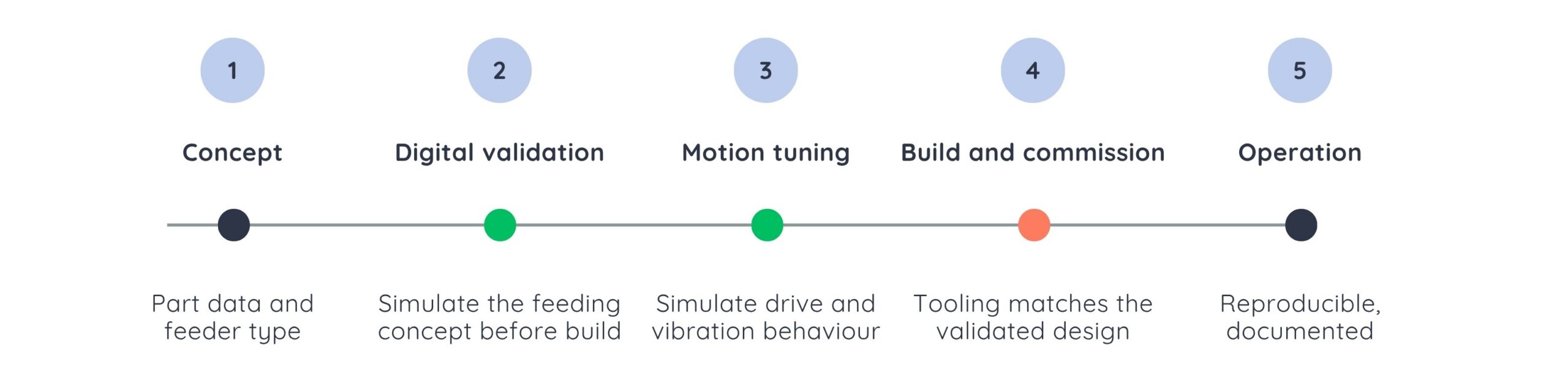
Even at concept stage, vibratory bowl feeder simulation can determine whether a component can be fed reliably before any hardware is built. Through RNA’s Digital Solutions service, multiphysics simulation and deep learning validate automation processes before physical production begins:
Digital Feeder™: Provides complete system-level simulation for part behavior, track flow, and orientation sorting.
Digital Motion™: Analyzes drive dynamics, acceleration, and vibration behavior to optimize feeding speed and stability.
Eliminating Commissioning Delays in the Project Timeline
In a conventional process, the first real test of a design’s assumptions happens at commissioning — the most expensive point to discover an error.
RNA’s process instead runs feasibility and validation as simulation stages before mechanical design is finalized, with build and commissioning coming last.
That sequencing has two effects. First, risks and constraints get identified early, before tooling exists. Second, because the design has already been tuned virtually, the physical build stage needs less on-site tuning and behaves more predictably once running. Commissioning becomes a step to confirm a validated design, not the point where the design is discovered to work or not.
It also helps when a part changes later — often the more common scenario than a clean-sheet project. Digital tooling data simplifies changeovers, reducing re-engineering effort for part families and design updates.
Precision Manufacturing with 3D-Printed Feeder Tooling
A simulation is only as useful as the fidelity between what it predicts and what gets built. RNA’s tooling is CNC-milled or 3D-printed, developed after simulation and assessment of the bulk material, with the optimal geometry calculated using multiphysics simulation and deep learning.
3D-printed bowl feeder tooling provides unmatched flexibility for high-mix manufacturing — bowls can be changed over quickly for different shapes and sizes, which is particularly useful in electronics and small-parts manufacturing. And because the tooling is digitally defined, systems can be reproduced reliably across lines or sites, not just the first build.
SPOTLIGHT
Discover RNA Digital Bowl Feeders
Digitally validated, AI-optimized bowl feeders designed for reproducible, high-performance feeding.
Using AI and 3D Geometric Deep Learning, RNA can create a digital twin of the feeding system, allowing it to be simulated, tested, and optimized virtually before the physical system is built.
The practical takeaway is about where design certainty appears in the timeline. In a conventional process, that certainty doesn’t arrive until commissioning, which makes early cost and schedule estimates provisional. In a digitally validated process, more of the technical risk is retired before tooling is manufactured, so early estimates carry more weight.
This isn’t a substitute for feeder engineering — it depends on accurate part data and simulation tools that have been proven against real results. For parts with well-understood handling behavior, the gains may be modest. For complex or unusual geometries, the case for validating digitally before building physically is strongest.
The broader shift is from discovering problems during commissioning to resolving them during design. Catching a feeding problem on screen is a design revision. Catching the same problem on the shop floor is a redesign.
Ready to Validate Your Feeder Design Virtually?
Don’t wait until commissioning to find out if your parts feed smoothly. Contact RNA today to learn how our Digital Solutions and vibratory bowl feeder simulation services can streamline your next automation project.
Get exciting news and updates in the future. See our Privacy Policy to learn how we protect your information.
We use cookies to give you the best experience on our site. By using our site you accept our Privacy policy. Accept
Manage consent
Privacy Overview
This website uses cookies to improve your experience while you navigate through the website. Out of these, the cookies that are categorized as necessary are stored on your browser as they are essential for the working of basic functionalities of the website. We also use third-party cookies that help us analyze and understand how you use this website. These cookies will be stored in your browser only with your consent. You also have the option to opt-out of these cookies. But opting out of some of these cookies may affect your browsing experience.