Originally posted on: January 10, 2024
Bowl Feeder vs. Centrifugal Feeder: Unravelling the Key Similarities and Differences
Author: Chris Mills

Part Feeders are a cornerstone of modern manufacturing, revolutionising the way components are sorted and fed into production lines. Two widely used options are vibratory bowl feeders and centrifugal feeders. In this article, we will explore the key similarities and differences between centrifugal and bowl feeders, shedding light on their respective strengths and applications.
Similarities between bowl feeders and centrifugal feeders
Purpose of Operation
Both bowl feeders and centrifugal feeders are designed to automate the process of sorting, orienting, and feeding components to a production line. They enhance efficiency and precision in manufacturing processes across various industries.
Component Orientation
Both types of feeders excel at orienting components in a specific direction. This is crucial in industries where the correct positioning of parts is paramount for the assembly process.
Customisability
Both types of feeders can be customised to accommodate a wide range of component sizes, shapes, and materials. This adaptability ensures their versatility in different manufacturing environments.
Durability and Longevity
When properly maintained, both bowl and centrifugal feeders are known for their durability and can withstand the demands of high-volume production.
Differences between Bowl Feeders and Centrifugal Feeders
Feeding Mechanism
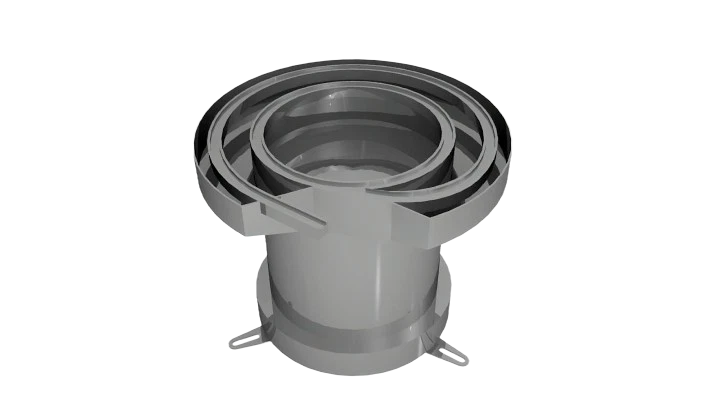
- Bowl Feeder: Operates on vibration. It utilises electromagnetic or mechanical drives to generate controlled vibrations, moving components along a circular or spiral track.
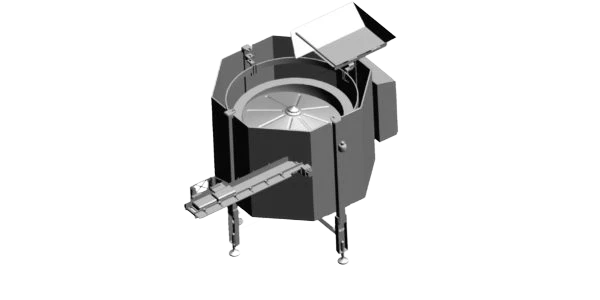
- Centrifugal Feeder: Operates on the principle of centrifugal force. A rotating disc with pockets or grooves guides the parts towards the outer edge where they are collected and fed.
Orientation Options
- Bowl Feeder: Can be equipped with various tooling and mechanisms to change the orientation of parts, allowing for a wide range of orientation possibilities, including upright, sideways, flat, etc
- Centrifugal Feeder: Better-suited for scenarios where a consistent stream of parts is needed rather than for intricate selection processes
Flexibility in Component Size
- Bowl Feeder: Can handle a broader range of component sizes, making them more versatile for different applications.
- Centrifugal Feeder: Well-suited for small to large-sized components, but better suited for parts with consistent dimensions and geometries.
Speed and Throughput
- Bowl Feeder: Capable of achieving high speeds, with some models specifically designed for ultra-high-speed applications.
- Centrifugal Feeder: Often known for higher throughput rates, making them ideal for high-speed production lines.
Control System
- Bowl Feeder: Standard control system
- Centrifugal Feeder: Programmable controller
Noise Levels
- Bowl Feeder: Depending on the design and manufacturer, they can produce varying levels of noise.
- Centrifugal Feeder: Generally operates with lower noise levels, contributing to a quieter work environment.
Choosing the Right Feeder for Your Application
While both bowl feeders and centrifugal feeders serve the same fundamental purpose, their unique mechanisms and characteristics make them better suited for different scenarios. Understanding their similarities and differences empowers manufacturers to make informed choices, ensuring an efficient and productive production line tailored to their specific needs. By leveraging the strengths of these feeding technologies, manufacturers can unlock new levels of efficiency and precision in their operations.
Also available in:
 English
Last edited on: October 21, 2025
